It starts in our van.
Tap water contains dissolved minerals such as calcium and magnesium. When hard water dries on glass, these can leave visible spots.
Warm water helps loosen everyday dirt and grease, making cleaning more effective.
This site uses cookies for analytics and advertising. Accept them all, decline them all, or choose which ones you allow. Learn more in our privacy policy.
Cambridge has very hard tap water. If we rinsed your windows with ordinary tap water, dissolved minerals could dry into obvious white spots and streaks. Follow how we remove those minerals for a naturally clear finish.
An interactive illustrated guideTap water contains dissolved minerals such as calcium and magnesium. When hard water dries on glass, these can leave visible spots.
Warm water helps loosen everyday dirt and grease, making cleaning more effective.
Cambridge is known for very hard water. Ordinary tap water can leave unsightly chalky mineral marks on glass as it dries. Our purification system removes virtually all the dissolved minerals, so after brushing and rinsing, your windows can dry naturally without the usual hard-water spotting.
We use thermostatically controlled hot water, typically around 35–65°C depending on the setting and conditions. It helps loosen greasy residues and stubborn grime, and makes first cleans more effective. We choose suitable temperatures for the surface.
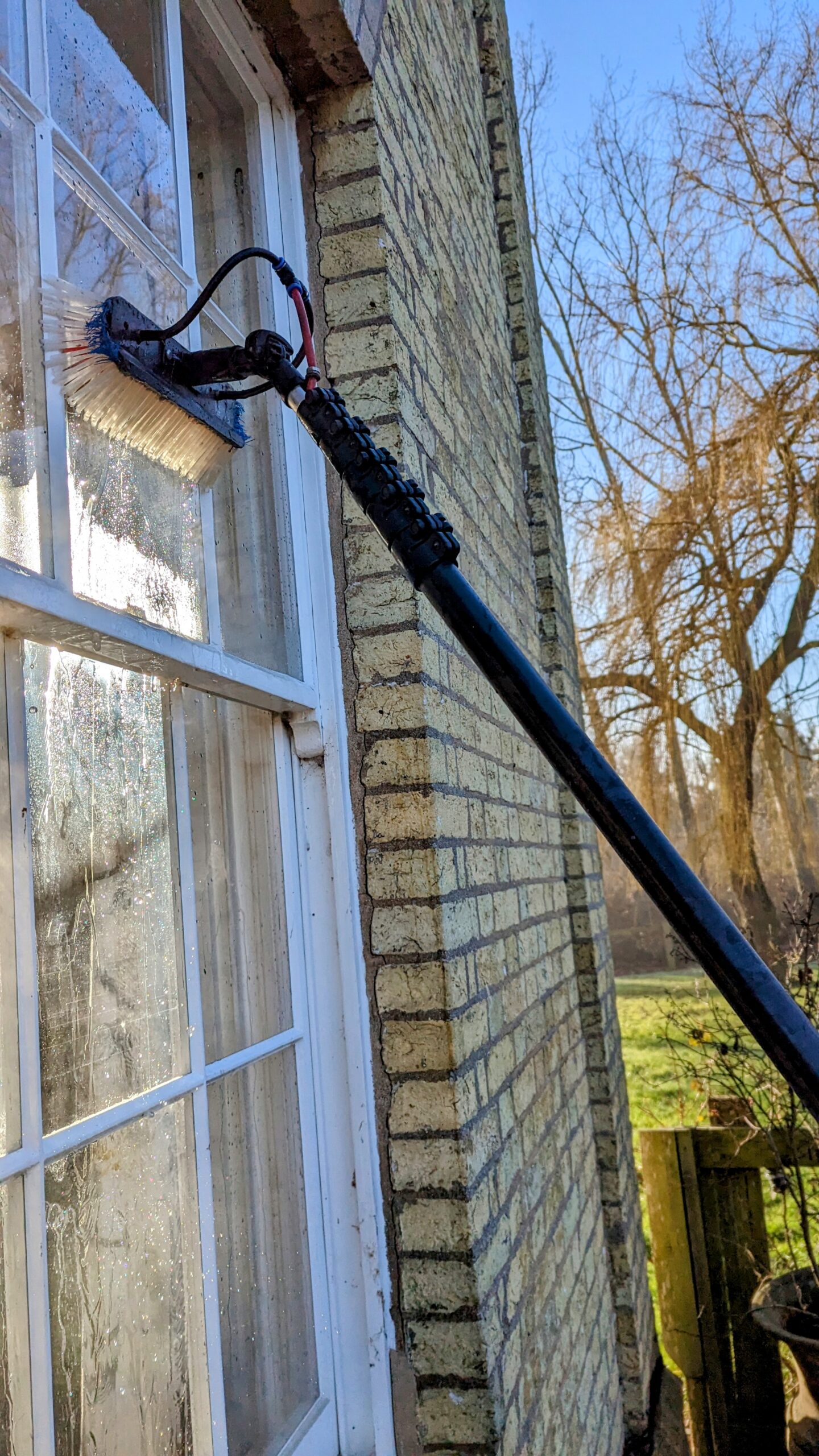
With Cambridge’s very hard tap water, leaving a normal tap-water rinse to dry would risk obvious mineral spots. Instead, the specialist brush removes contamination, flowing pure water rinses it away, and the low-mineral finish can evaporate naturally.
We're experienced in cleaning traditional windows, including the painted wooden frames and delicate glazing found in many thatched cottages around Comberton and neighbouring villages.
With the right specialist brushes, controlled pressure, careful attention to the condition of the paint and putty, and suitable water temperature, we can achieve excellent results on many older windows.
We adapt our method to each property. Fragile paint, loose putty or damaged timber may need special care or a different cleaning method.

Yes. Our heated system lets us work through much of the winter, often down to around −2°C. But the critical issue is not just getting hot water to the window — it's what happens when that water reaches the ground.
Drag the thermometer up or down to explore the conditions.
We can often still get hot water to the glass, but must check for icy paths, runoff and unsafe ground conditions.
Rain is usually no problem. It can even make cleaning easier because it softens dirt. We still take account of heavy wind, unsafe conditions and dirt being washed onto the glass.
Below around −2°C, water can begin freezing on the ground and create dangerous slippery surfaces. Even with heated water, we'll postpone when the conditions make cleaning unsafe.
Our purified-water method means we don't normally need conventional window-cleaning detergents for routine exterior work. Heating and filtration do use energy and water, so we don't pretend the process has no environmental impact.
The concentrated reject water from our reverse osmosis system goes through a sprinkler system into our garden rather than straight down the drain. In our own experience, the plants have thrived with the extra water and minerals.
This is our experience, not a recommendation to use RO concentrate on every garden: suitability depends on the source water, salt levels, plants and soil.
Because properly purified water has very little dissolved mineral content. Once we've loosened and rinsed away the dirt, it can dry naturally without the usual hard-water spotting.
Yes. We find it improves cleaning, especially on greasy residues, stubborn grime and first cleans. We still select the appropriate temperature, brush and technique for each property.
Yes. Traditional and delicate windows are one of our specialities, including older properties and thatched cottages near Comberton. We inspect their condition and adapt our brushes and method accordingly.
Our heated-water system and technique help us achieve great results on first cleans. If a rare issue occurs, we're happy to return and sort it out free of charge.
Yes. Rain often softens dirt and can make cleaning easier. We only postpone when conditions such as high winds or unsafe access make work unsuitable.
We often work down to around −2°C when conditions permit, but freezing runoff on the ground can make it unsafe. We assess each situation and postpone when necessary.
No. They're produced by different methods. Our reverse osmosis and deionisation system produces water with extremely low dissolved mineral content, suitable for spot-free rinsing.
From modern homes to delicate wooden windows and thatched cottages, we tailor our approach to the property. Serving Cambridge, Comberton and surrounding villages.
Get a window cleaning quote →Learn more about our window cleaning service.